
It's Not Just About the Workout: 4 Ways to Bring Somatics Into Your Movement Practice
This blog is a primer on the concepts I introduced in a recent webinar called Bringing Somatics Into Your Workout. You can watch the class & try a somatics-centered workout here.
What Does Your Body Want From Your Workout?
At Mind & Mountain, we've always been about bridging the gaps between physical and mental health. Over the years, though, the cognitive-based (top-down, thought-shifting) strategies that I learned, practiced, and taught started to feel like holding beach ball underwater: I could keep things contained, but it took constant effort
Somatic work has helped release some of the air from that beach ball - letting it deflate little by little, so there’s less noise happening underwater and thus less effort to contain it. And wow, what a relief that has been!
Somatic nervous-system regulation is about learning to listen to our bodies and offer the support they’re asking for. That’s easier said than done, but it’s well worth the practice. My personal experience is that this work has totally transformed my relationship with movement - to the point that I’m experiencing an athletic renaissance in my mid-40s!
For the last year, I’ve been weaving these skills into live workouts I teach inside the Mind & Mountain Training ecosystem - we now have somatic-centered versions of nearly all the Ski Babes and Summer Strong workouts, and I’m continuing to refine this body of work as it grows.
I’m also interested in sharing the skills we’re exploring in these workouts, so you can build them into your regular movement practices too - whether that’s in the gym, inside the M&M ecosystem, or out in the mountains.
Let’s dive into what bringing somatics into your workout means: how to practice it, why it matters, and how those skills can support you beyond your workout.
What Does It Mean to Bring Somatics Into Your Workout?
Simply put, bringing somatics into your workout means paying attention to your body’s sensations and responses. Then listening to that information and working with it skillfully, letting the dialogue influence how you move through the workout.
At its heart, this is a practice of relationship with our bodies, instead of dominance.
One way to start this exploration is with this question: “I know what I want my body to do, but what does my body want to do?”
Can both of these voices be part of the conversation?
It’s an inquiry that can take some practice, but once you get the hang of it, it can change everything.
Activation ≠ Automatic Danger
First things first, the goal of nervous system regulation is NOT to have a nervous system that’s always calm.
The goal is to have a nervous system that is adaptable and has access to range. It can move in and out of rest / activation / deactivation / settling in accordance with the situation at hand.
Activation has gotten kind of a bad rap these days, and I hate to see it because activation is such an important part of our somatic toolkit.
Activation can be intense fight and flight energy. It’s also the sympathetic nervous system charge we use in our workouts and outdoor time. It’s the energy that gets us up a mountain, through a heavy lift, or an intense interval.
At its core, activation is the potential for movement and action.
Have you seen the Comfort Zone/Stretch Zone/Panic Zone model? I’ve started overlaying it onto the Nervous System Window of Capacity/Tolerance and using this combo to show how the following skills help us expand our capacity through supporting the different zones. This piece needs more nuance than I’m going into here, but I’d invite you to the webinar if this resonates.
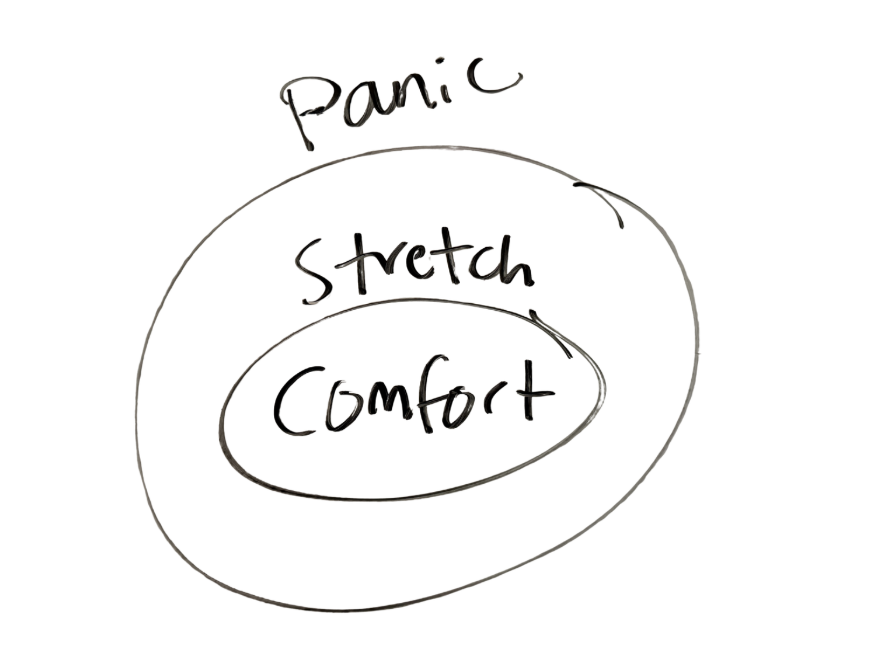
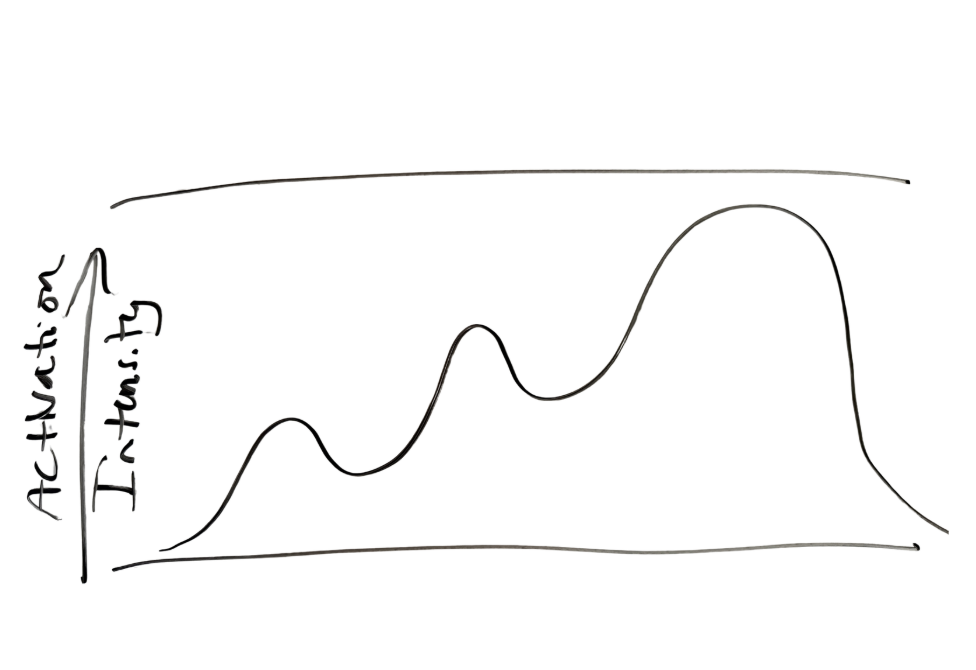
Workouts are such a fertile practice ground for this because they give us repeated opportunities to practice moving between challenge and recovery. In fact, the activation arc of a workout maps pretty well onto the arc of a somatic therapy session:
Four ways to practice somatic skills during a workout
You don’t need to add a whole separate practice to your day to build somatic skills. A workout offers plenty of opportunities to notice what’s happening in your body, respond with care, and explore something different.
1. Notice what helps you feel safe or supported
This is the work of expanding and stabilizing the Comfort Zone. In nervous system terminology, we’re using strategies like Orienting and Resourcing to notice the safety cues available. And we’re learning what our bodies need to be able to take in this kind of quieter information alongside the louder discomfort signals.
The three primary somatic skills inside this bucket are:
- Noticing safety cues
- Connecting with pleasant sensory experience
- Tracking change
Note on building somatic skills: This work typically begins with noticing and bringing attention to new experiences in the body. As the nervous system becomes more practiced at it, these skills move from “requiring focus and attention” to “happening mostly automatically in the body.” In this class, I introduced a self-assessment tool to evaluate where you are inside this process on a 1-5 scale. Again, we’re not getting into the details here but if this aspect speaks to you, and you’d love a way to track and measure please engage with the full webinar.
2. Practice effort, enoughness, and recovery
This bucket is where we practice moving between the Comfort Zone and the Stretch Zone, and in nervous system terms, practicing Pendulation and Titration.
Every time you’re doing an effortful push with your body, you’re moving into activation.
Then you have an opportunity to listen for enoughness - often an underdeveloped skill, since we’re used to using external signals to determine enoughness instead of listening internally.
After the effort, our bodies move into the deactivation phase of the cycle, which is another quieter experience that we’re often not practiced at noticing.
The somatic skills for this bucket include the following:
- Noticing Activation
- Tracking Enoughness
- Noticing Deactivation
3. Explore challenge while staying connected to safety
The most challenging part of the workout is practicing uncoupling activation from threat. This is the work of expanding the Stretch Zone, and noticing the threshold between Stretch and Panic. Just because we’re working hard physically doesn’t mean we’re in a fight-or-flight situation, though our nervous systems might need help remembering that!
This is the bucket where we practice experiencing intensity and simultaneously maintaining a tether to our resources.
I’m especially passionate about this bucket because it relates to our ability to accurately evaluate intense moments (including crisis situations), identify resources and risks, and assess our true capacity in those moments.
The somatic skills we’re building here:
- Noticing choice and capacity, aka “Can we stop if we need to? Do we need to?”
- Maintaining a tether to resource
- Noticing pleasure (or okayness) signals
4. Let yourself arrive at completion
The final bucket we’re exploring is the back side of the activation wave: deactivation, settling, integration, and celebration (pronking).
This piece of the work is important to many folks - so often I hear people say they just need help moving out of activation and achieving a calm state.
The reality is, this piece of the work IS tricky for many of us. This branch of the nervous system (parasympathetic) literally moves slower than the activating one (sympathetic) for most of us. One reason is that the parasympathetic branch is unmyelinated, meaning it lacks the protective sheath around its nerves. This means that the “we’re done, it’s time to deactivate and settle now” message does just take longer to get around.
And we can practice! Notice if, during the slower moments at the end of a workout, your brain jumps ahead to your to-do list or whatever it is you have to do after the workout. This is a classic experience of jumping into the next activation cycle instead of letting the current one fully settle and land.
Here are the somatic skills we’re working on:
- Staying with deactivation
- Noticing satisfaction
- Noticing celebration impulses (pronking)
Strength You Can Take With You
These skills apply directly inside our workouts and our outdoor time, hooray! And beyond that, they are skills we all need for the emergent times we’re living in.
For example:
- Recognizing when you need a break: Pausing on a steep trail to take a break because you needed it and fighting (less at least!) with the voice in your head telling you it will slow everyone down.
- Setting a boundary: Noticing the discomfort of saying no while staying connected to your needs and choices.
- Trying something new: Making room for nerves alongside curiosity, enjoyment, or a sense of support.
- Having a tough conversation: Noticing when you’re getting activated, feeling your feet on the floor, and choosing whether to keep talking or ask for a pause.
- Staying politically engaged: Recognizing when you’ve taken in enough for now, stepping away, and giving yourself time to settle before returning.
- Activating for good: Using your activation energy to engage with a cause you care about, create something, connect with community, and build the future we want to live into.
- Recognizing enoughness: Ending a workday, leaving a gathering, or adjusting plans before you’re completely depleted.
The list could go on and on!
Moving from concept to practice
There are layers to this work. Some I can convey here in writing, and others require more space to explore in depth.
I hope this writing helped you get a sense of where this work could go for you. If it is striking a chord and you’re ready to explore more, the next step would be the full Bringing Somatics Into Your Workouts webinar.
Alongside the webinar, we’re including one of my recent somatic-centered workouts for you to try as a practice space if you want.
There are two ways to access this next piece:
- Get the webinar + workout sent straight to your inbox
- Sign up for our free week trial and get free access to the Bringing Somatics Into Your Workouts webinar plus my entire training ecosystem for seven days.
- One perk of this option is access to the full library of somatic-centered workouts that I’ve been building as I refine this body of work. It’s been a very supportive practice ground for me, and many participants have told us the same. You may find you want to stick around!
Whether you decide to continue on to the webinar or not, thanks for being here. Cheers to finding more supportive ways to move and learning to support our bodies along the way. 🥂