
The Strongest I’ve Felt in Years: How Nervous System Work is Changing the Way I Move
This blog post was inspired by two episodes of my podcast, Coregulation Conversations - Episodes 52 & 53. If you'd rather listen than read, you can find them here.
What Came After Letting Go
I’m having an athletic breakthrough at 44.
Which is not necessarily where I thought this story was going.
If you’ve been around for a while, you know that for the past handful of years, I’ve been in a slower season. My priorities shifted through my fertility journey and a deep dive into somatic nervous system healing and studies. My body wanted to move slower, and instead of pushing, I listened.
Indeed, letting go of the assumption that I would eventually get back to the athlete I had been was a very important part of that season.
From where I’m standing today, it was clearly a worthwhile process - even though it took a lot of time to untangle my sense of worthiness from my athletic ability.
For a long time, that ability had been where I found safety. In my ability to keep up, do impressive things outside, and identify as a strong person. It’s where I felt belonging, so untangling all of those threads was a lot to work through.
In retrospect, I can see that there was a nervous system survival question at stake here. My body needed to know I’d be okay - aka I’d feel the social nervous system requirements of safety, worthiness, & belonging - even if I never returned to the level of fitness I’d had before.
And then, somewhat unexpectedly, this summer I found my way back.
Except it doesn’t feel like going back at all.
It feels like something completely new.
An Unexpected Athletic Comeback
I started to notice a shift in my nervous system capacity last winter. My skate ski outings started to feel different, like I could push harder on the uphills without shifting into my nervous system’s default override pattern that I’d been trying to repattern for years.
Then moving into summer, our Brooks Range trip kicked off the season with a great dose of hiking, challenge, and reward.
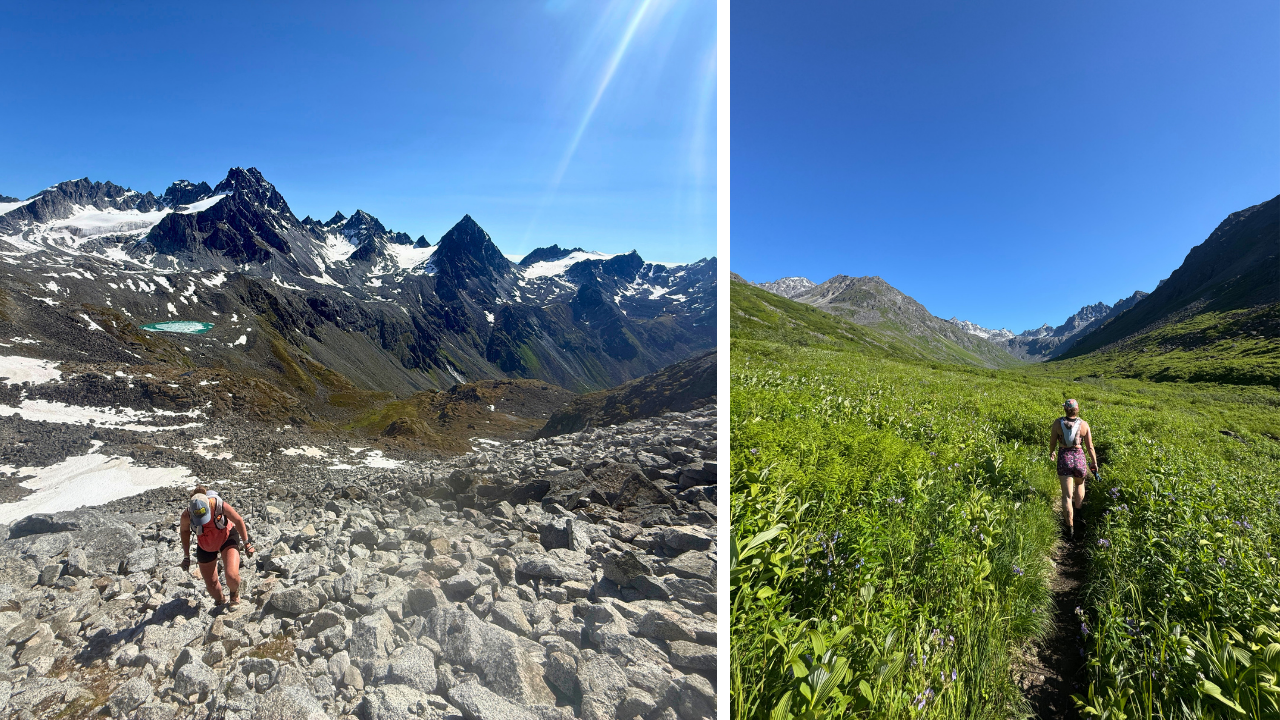
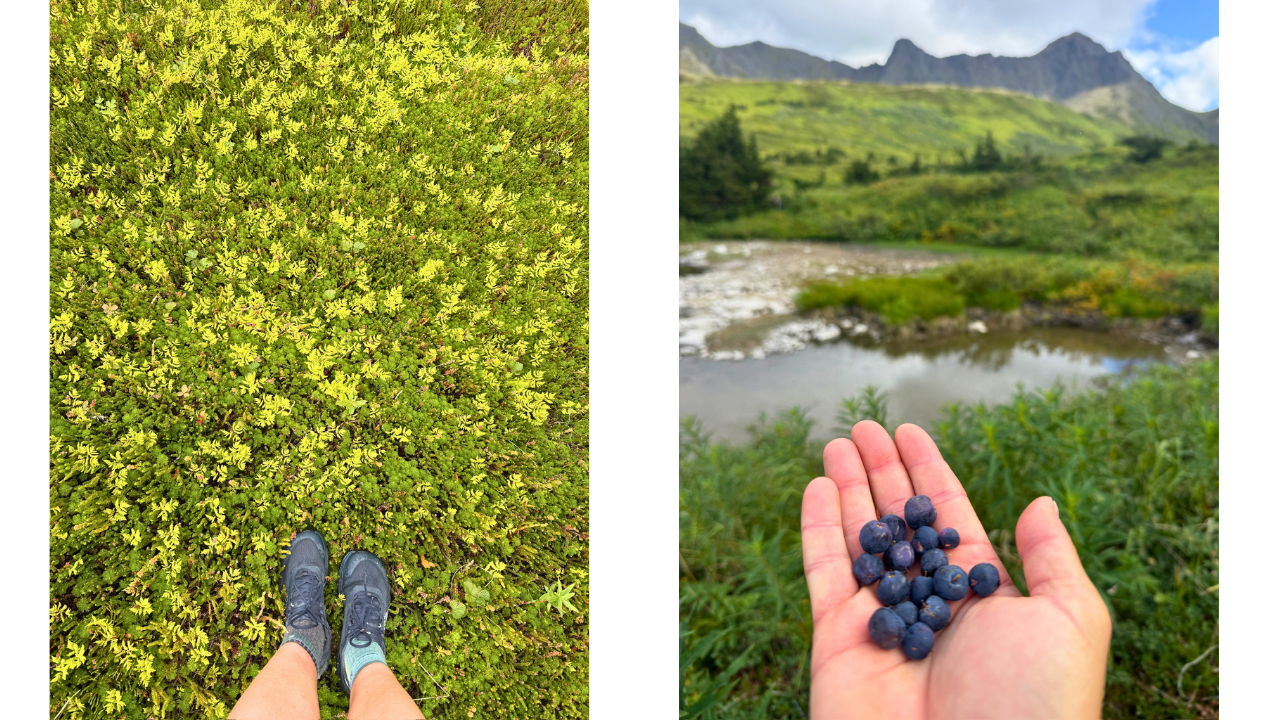
When I got home from that trip, I started doing long day hikes and trail runs around the Chugach. I say “trail running,” but really it’s mostly hiking with a little bit of running here and there. It’s a different way of moving than I’ve accessed before though, covering more ground in a day than I thought I could.
And I’m having SO MUCH FUN.
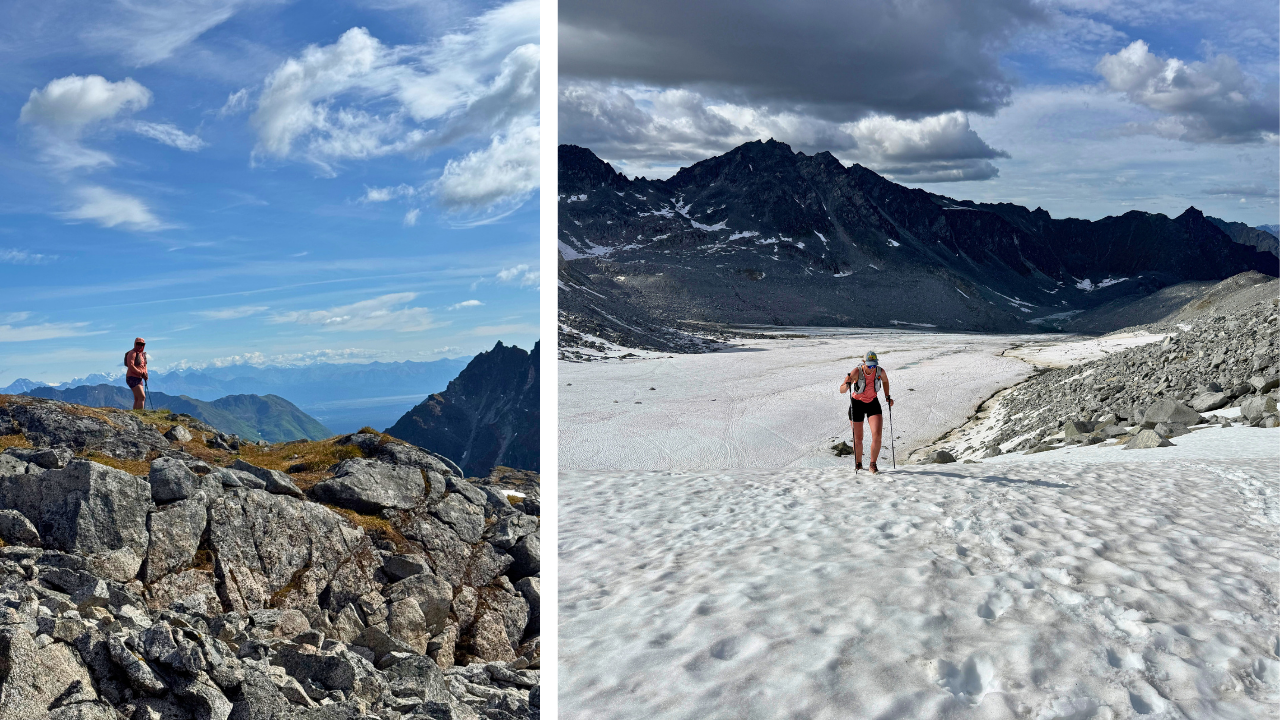
With the help of my friend Hannah, I’ve started linking together places I’ve visited separately over the years. Trails, ridgelines, backcountry routes, and mountain passes are suddenly connecting into these huge, beautiful days.
One of my first big wins in this story arc was completing a backcountry route in a day that I had previously only done as a three-day backpacking trip.
That kind of blew my mind - actually, it REALLY blew my mind, and settled the fact for me that I’m having somewhat of an athletic renaissance. I’m PRing my longest hiking days in my 40s, after years of not knowing whether this version of athleticism was something I’d experience again.
But the distance isn’t actually the most interesting part to me. What feels more significant is how different it feels inside my body.
I’m doing hard things without automatically overriding myself.
I’m experiencing discomfort in a new way - without my body interpreting it as something wrong.
My body’s sense of activation has become more neutral. Feeling activation without interpreting it as a threat.
And my nervous system has learned how to deactivate and settle, which has shifted my baseline state.
As I’ve started to talk about this, I’m seeing four categories of nervous system work that have supported this shift.
1. My Body Feels Safer
One of the biggest changes is also the simplest to describe: my body generally feels safer.
My nervous system has a different baseline than it used to.
There was a time when questions like Am I safe? Am I okay? Am I doing this right? seemed to be humming quietly underneath a lot of my experiences.
This mostly wasn’t conscious, but even unconsciously, this sense of hypervigilance was running the show.
Athletic achievement could temporarily quiet that question, almost like a recipe:
- Do something hard.
- Keep up.
- Prove that I belong here.
- Feel relief.
But then, of course, I’d have to do it again.
Once I started studying somatics, I learned how important it was to practice noticing safety too.
Our bodies are naturally really good at detecting potential threats. The quieter cues that things might be okay can require more practice.
In somatic work, we use skills like orienting and resourcing to help with this. Orienting can be as simple as noticing what your senses are taking in right now. Resourcing might mean allowing your attention to stay with something that feels supportive or pleasant.
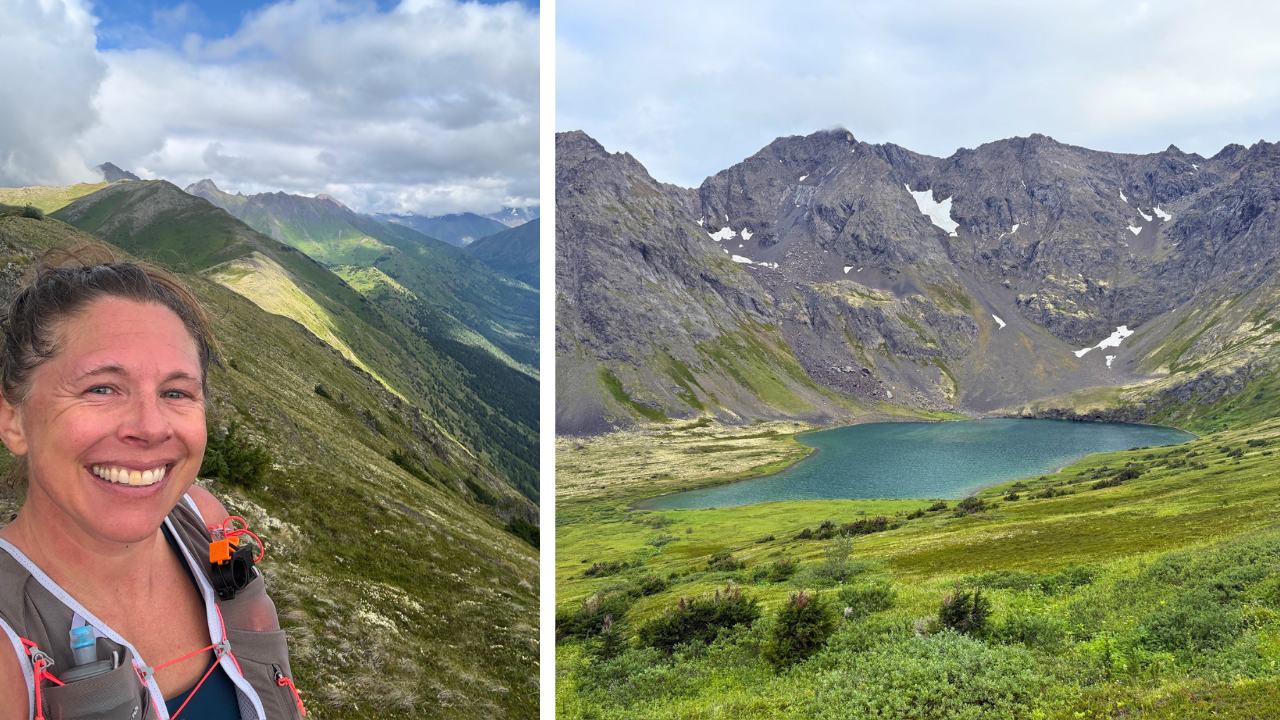
On one of the hikes where I recorded a couple of podcast episodes that inspired this blog (Coregulation Conversations Episodes Ep. 52 & 53), I had a moment where I was standing on a ridge above a gorgeous lake, with mountains and glaciers surrounding me, watching the evening light begin to shift.
I could actually let my body notice how beautiful it was, and I could feel those observations nourishing me.
This isn't something you learn once and finish, it’s slow, repatterning work that takes a lot of practice, which is why for me, somatics has become more of a lifestyle, a way of being in relationship with my body and the world, than just a therapeutic modality.
And as my baseline has settled, I’ve gained more capacity to move toward challenge without tipping so quickly into overwhelm.
2. I’ve Learned to Let Activation Move Through
Here’s one of my favorite ways to describe what my nervous system used to feel like.
Imagine turning on a gas stove and letting the gas run for a few seconds before lighting it.
When the flame finally catches:
🔥WHOOSH 🔥
There’s already so much gas hanging around that a tiny spark creates a huge response.
My nervous system used to feel a bit like that. There was already a lot of ambient activation in my body. It didn’t necessarily take much for something to create a BIG response.
I remember this happening while wild ice skating. The ice would make one of those legitimately spooky cracking or popping sounds, and my body would respond with a huge jump, gasp, adrenaline rush, the whole thing.
Now, the stove feels more like it’s simply on low.
Something happens, and my system can respond to that thing, rather than that thing plus everything else it has been holding. To complete the metaphor - it’s a lot easier to cook with!
A big part of that shift has involved learning about discharge, the body's natural process of moving activation through and completing a stress cycle.
Sometimes that might happen after a stressful moment. You cross an intense river, reach solid ground on the other side, and notice your body wants to shake out some of that energy.
But many of us have also spent years overriding those impulses - I certainly had.
And when the body repeatedly gets the message to contain, suppress or push through, some of that activation can stick around in subtle and not-so-subtle ways.
Learning to discharge isn’t simply “shake your body and release the trauma,” despite what Instagram might have you believe. For me, the deeper work has involved enough safety, attunement, co-regulation, and care that my body can begin to release some of that holding organically.
That has been slow, deeply physiological work, and work I’ve invested significant time, money, attention, and therapeutic support into. I don’t want to pretend otherwise. It is a privilege to have resources to devote to this work. And that’s part of why finding ways to spread this information outside of 1:1 therapy via small groups, podcasts, blogs, interests me so much… but I digress!
The result of all of this has been more space inside my system.
And more space changes what becomes possible.
3. Uncoupling Activation From Threat aka Hard Doesn’t Have to Mean Dangerous
This one has been HUGE for my athletic life.
Our sympathetic nervous system is responsible for fight and flight. But that same system also gives us:
- Power.
- Motivation.
- Momentum.
- Drive.
The energy to climb a mountain or advocate for something we care about.
Activation itself isn't necessarily a problem.
But for many of us, activation and threat have gotten kind of… smushed together.
Your heart starts beating faster. Your breathing changes. Your muscles are working hard.
And the body interprets those sensations as:
Something is wrong.
This is part of why anxiety and excitement can feel so similar in the body. Both involve activation. Our experience of that activation can be very different depending on whether we also feel safe.
For me, uncoupling activation from threat has transformed how physical effort feels.
We can get a sense of our activation levels by tracking thought patterns, and mine were often like this:
😰I’m too slow.
😰I’m working harder than everyone else.
😰I’m not as good an athlete.
😰I’m behind.
Now I can experience some of those same physical sensations and stay connected to a sense of okayness, sometimes even pleasure.
🤩Wow, my body can do this.
🤩Look where my legs are taking me.
🤩This is hard AND this place is incredible.
🤩Hard can just be hard.
🤩This is hard, and that’s how it’s supposed to feel.
It doesn’t automatically mean there’s a problem to fix or an experience to override - and it turns out that leaves a lot more room for fun!
4. I’m Learning the Feeling of Enough
This might be the least flashy piece of an athletic breakthrough, but I think it’s just as important as everything that happens on the mountain.
I’ve had to learn how to come back down.
How to settle.
How to integrate.
How to feel satisfied.
How to let something be enough.
When your nervous system is accustomed to running at a higher level of activation, slowing down can actually feel uncomfortable.
There can be a stickiness to an activated nervous system state. Even after the hard thing ends, the body doesn’t necessarily know how to leave that state. Settling requires its own practice.
I’ve had to learn, physiologically, that I can be both safe and soft.
I don't always need to be braced.
I can have little moments of deactivation, spend some time there, and eventually stretch those moments out.
There is so much cultural conditioning wrapped up in this too. Performance. Maximizing. Doing more. Pushing our bodies instead of listening to them.
So even though “learn to rest afterward” sounds simple cognitively, the body might need patience, practice, co-regulation, and support to actually believe it.
For me, this ability to come back down is part of what makes going up feel possible again.
And it has reset my nervous system baseline, so I have space to encounter challenge without immediately being overwhelmed by it.
This Version of Strength Feels Different
The coolest part of this whole experience is that I wasn’t chasing an athletic comeback; I had actually been practicing letting go of needing one.
And now here I am, 44 years old, covering more miles through the mountains than I ever have before and having an absolute blast doing it.
The physical results are fun because they’re tangible. I can point to a route that once took me three days and say, Whoa. I just did that in one.
But I don't think athletics are the only place these shifts show up.
The same nervous system supports our relationships, creativity, work, advocacy, outdoor recreation, and the ways we care for ourselves and other people. The athletic changes are simply easier to see.
And maybe that's what feels so exciting to me about this season.
This strength isn't coming from being better at overriding my body. It isn't about proving that I still have it. It isn't even really about getting back to who I was. It feels like finding out what's possible when my body and I are actually on the same team, and it turns out, we can go to some pretty incredible places together.
If something here sparked curiosity for you, you might notice which of these four areas feels most alive right now: safety, discharge, experiencing activation without threat, or settling into enoughness.
You don't necessarily have to do anything with the answer right away - just notice.
Somatic work has taught me again and again that insight is only one piece of this process. Our bodies also need practice, support, time, and, often, other safe bodies to learn alongside.
Take good care of yourself, your people, and the land where you are. And perhaps find something beautiful to notice while you're at it.
—-------
We’re continuing this exploration at Mind & Mountain, through workouts, connection to nature, and somatic practices. If you’re interested in incorporating somatic work into your life, I’d like to invite you to join me inside the Mind & Mountain Training Membership. The recent workouts I’ve recorded are somatic-centered and are a place to join others in the practice of learning to listen to and work with our bodies and nervous systems.